Wednesday, January 31, 2007

Radio New Zealand National...

...sounds like patronising branding bullshit.

Hold on, I'm already listening to you. You don't need to sell me on the "product" or create "brand awareness". Save the money on the marketing hack who came up with this nonsense and hire another reporter.

Monday, January 29, 2007

Dead Possums and Nice Views


One of the fantastic things about the Roskill area is the interesting and varied natural environment. Not many people know it, but snaking along the Manukau Harbour foreshore is the largest area of native bush on the Auckland Isthmus.

This bushy strip starts out where SH20 winds down towards Onehunga, continues along the coast around Hillsborough, nestles around a number of bays and beaches at Waikowhai (my local patch) and Blockhouse Bay, before continuing on towards Green Bay and beyond. There is an impressive array of native bush, historic tracks and buildings, and native birdlife within the area.

In amongst the Punga, Puriri, and Pohutakawa, are signs of the areas colonial heritage. A cobbled road that once carried log laden wagons from the Waitakere’s can still be spotted at some points, and there is an old abandoned stone building in the Waikowhai reserve that presumably serviced this trade.

This urban oasis is however under threat from filthy, dim-witted, aggressive, venereal disease infected Australian ex-pats. Possums (along with assorted other pests of the rodent-kind), loads of the buggers, make their syphilitic homes high in the trees along the foreshore where they alternate between breeding and gorging on the native flora. Once the trees and berries are stripped by possums, there is precious little room or food for our unique (but pretty helpless) native birdlife.

This is where Auckland City’s volunteer programme comes into play. The programme is co-ordinated by a Council Officer who organises groups of local people to run pest control programmes, plant trees, maintain tracks, clear rubbish from waterways, and a range of other activities at some of the major parklands across Auckland. The programme at Waikowhai has been running since 2004, and has focussed on pest eradication – this being the first step needed to create a wild-life sanctuary right on the Auckland isthmus that could potentially be fenced off as a predator-free zone for the introduction of a wider variety of native birds.

I became involved in the programme in 2005, and have over recent months gone out a couple of times per week to check and clear traps. It’s a fantastic opportunity to get some exercise, enjoy the local scenery, and contribute something locally. Anyone in Auckland interested in volunteering in a similar way should just follow the link above.

I’ve attached a few photos of the reserve from around Lynfield where I have been active recently. If anyone wants any more information about the various tracks along the Manukau, then feel free to e-mail me.

* Photo's aren't uploading at the moment but I'll add these later.

Thursday, January 25, 2007

New Blogger

Have a look at single malt social democrat

Carl is a friend of mine, with a tinder dry sense of humour whose blog will be well worth watching. I think he is going to blog on a combination of political issues and book reviews.

McMillan - Out (again)

A fourth obsession of mine is cricket, so for those of you who don't appreciate the great summer game, perhaps skip to the next post.

Cactus Kate has started a campaign of persecution against New Zealand batsman Craig McMillan. As far as campaigns of persecution go, this one is relatively justified.

McMillan’s stats simply don’t stack up. His average, and conversion rate to match winning 50s and 100s are just too low, even when put alongside the rest of the under-performing New Zealand top order.

Most critically in my view, McMillan has failed to develop as a player. Although the available records don’t allow for this, I am quite sure that a season by season analysis would show that his figures have not significantly improved, if at all, over the decade he has spent in the national team.

McMillan consistently plays with the same reckless abandon that is guaranteed to get him out for an insignificant score 7 times out of ten. With a decade of top flight coaching and experience he has failed to apply himself and remedy basic errors in his game such as his inability to leave good balls just outside the off-stump. Time and time again he is dismissed mindlessly wafting at balls that a more focused player would recognise as hard to play, and leave.

This happened repeatedly in his innings of 89 last week, and it was only a matter of luck that he was not given out caught behind while still in single figures. This lack of self-assessment and willingness to apply himself to improving his game is in my view the main reason he should not continue to be selected. It’s a pity because McMillan has some real batting talent, and when in form he sees the ball like a watermelon.

For several years now, my view has been that the logical replacement for McMillan in the team is Scott Styris. While is batting average is far from stellar yet, he shows signs of application and improvement. Critically too, in his shorter international career, he has been far more effective at turning starts into match winning hundreds – something the New Zealand team (a scratchy win over England notwithstanding) desperately needs.

Monday, January 22, 2007

Updating Blog

Quite a few of the details on this blog - website links, the blogroll, etc, have become pretty out of date since I was last regularly blogging in mid 2005.

I'm slowly updating all of these, so apologies for any dead links, and the lack of new links. If you have a blog or site that you would like added please just leave a comment here.

Cheers,
Michael.

Sunday, January 21, 2007

Labour in 07: Investment

The PM has given some clear indications about the government’s policy priorities for the year, and fairly typically the mainstream media has failed to provide much analysis or comment on this. The media focus is very much on the issue of caucus and cabinet renewal, but it is a mistake to think that renewal is just about different bums on parliamentary seats – it is not. A renewal of ideas, policies, and thinking is just as critical.

Think about the National administrations of 1990 – 1999. In terms of the personnel, there was actually significant turnover, particularly of those at cabinet level. Jim Bolger, Max Bradford, John Banks, Philip Burdon, Paul East, John Falloon, Peter Gresham, Doug Kidd, and Denis Marshall are just some of the Ministers who turned over between 1993 and 1999. National’s Leader, Deputy, and Finance spokespeople all turned over within the three terms. Yet by 1999, the National government (crippled admittedly by a series of dodgy coalition arrangements) was seen as tired and out of ideas.

So the vigour and vitality of a government is about far more than simply how new the MP’s and Ministers are. While it is clear that some new blood in the Labour lineup is needed over the next year or so, renewal is about far more than this. The PM’s recent comments have been positive in this regard. She has highlighted the following issues as key areas for work over 2007:

Education

Education has been highlighted as “the area (where) the initiatives need to go”. This is an excellent move. There is a clear need for increased investment, particularly in the compulsory sector where the case for increased operational funding is strongly made - and doing so will highlight the emptiness of John Key’s “aspirational” rhetoric. We will need to contrast increased investment in our schools with National’s default setting in this area – attacking teachers, whinging about NCEA without providing any solutions, and banging on about bulk funding as if it actually does anything to improve the delivery of education to children.

The same should happen in regards to the implementation of the 20 hours per week free early childhood education policy. Getting every single three and four year old into early childhood education is one of the best things we can do to ensure that literacy, numeracy, and social cohesion improve – particularly in our poorer communities. This is an expensive policy and the implementation is difficult (the intransigence and greed of many private providers being a significant obstacle), but it is happening, and Key needs to be made to front up on whether a future National government would continue the investment, or spend the hundreds of millions on tax-cuts for mates in the Parnell millionaires club.

If by the end of 2007 we have seen a significant increase to Operations funding for schools, fulfillment of the 20 hours free policy, and progress on the election pledge of reducing class sizes to fifteen for five year olds, then Labour will be able to head into election year with a clear record of using our national resources to invest in the core public services that matter to most people.

Climate Change

With several policy papers out for public consultation, the government has succeeded in starting a national conversation about the issue. While it is clear that there are no quick and easy fixes, and that a strategy needs to be rolled out over a number of years to reduce our greenhouse gas emissions, it will be important that some policy work is concluded in 2007. Some tangibles need to be implemented by late this year or early next.

There is a real sense that this issue has reached a tipping point. Some kind of action in 2007 is necessary both to ensure that we are meeting our ethical and international issues to reduce our emissions, and to contrast Labour’s action on the issue with National’s lack of commitment to environmental issues. Having a blue-green sector and saying that they believe in the concept of climate change has been relatively easy for National, but I see no evidence that they have any willingness to take on the challenge of reducing emissions if it offends key sector groups in agriculture and industry.

Auckland

The Stadium – decision made, argument over. Build it.

In her comments the PM has focused in on the issue of regional governance and public transport. It is apposite that the two are bracketed as (in part at least) many of Auckland’s public transport woes are down to a failure of regional governance.

After the botched Mayoral proposal to create a super-city (and co-incidentally a new role of Lord Mayor for one of their own), the government and the region have responded well to the challenge of modernising Auckland’s governance structure. The government provided leadership by making the call that change was needed, and setting a timeline. The region responded by engaging in a rare public discussion on local body governance, and then feeding the results back to government. The clock is ticking on this one with local body elections in October. A well-crafted proposal that unifies the region will be critical in ensuring that Auckland is ready for another million people in the next fifty years.

The PM’s other comments on Auckland focused around the rail network, and particularly the issue of electrification.

We know that increased investment in rail services through better stations and rolling stock, more regular services, the Britomart project, and double tracking have delivered increased rail patronage, and with it significant economic, social, and environmental benefits. It is critical that the investment continues. Electrification is a big part of this, as in my view is an expansion of the network – starting with the Onehunga line. I will write more on this later. Needless to say, a government backed plan in 2007 to proceed with electrification would signal a major commitment to investing in Auckland’s future.

It’s about Investment

All of the areas highlighted for attention in 2007 by the PM are about investment. To paraphrase economist JK Galbraith, “there is no point living in a society of private affluence, surrounded by public squalor”. Serious investment in our education system, meaningful movement on climate change, leadership on Auckland’s governance, and investment in the region’s public transportation network in 2007 will show that Labour is the Party that invests in our shared future.

Investment on this scale will signal to the country that this is a government that is renewing its ideas and policies more that one or two new MP’s will.

Friday, January 19, 2007

As the Bishop said to the Editor

The debate sparked by Bishop Richard Randerson’s recent comments in the Herald about the nature of God is significant for two reasons – the very fact that such a debate has taken place in the mainstream media, and the public intolerance displayed by some conservative Christians in response.

For several surprising days this week, the dialogue and letters pages of the national paper have been dominated by responses to the Bishop’s acknowledgment that there is no scientific evidence for the existence of God, and his belief in God as something other than a guy with a beard “up there”. Letter writers, guest columnists, Herald writers, and other clergy all chimed into the debate. There was conservative outrage at this “heresy”, plenty of liberal letters making great use of the word “inclusive”, and a strident band of atheists maintaining that every calamity and genocide in history was the fault of the previous two groups.

But there it was – a discussion about the nature of God laid out bare for all to see and think about. As the earlier heretic Lloyd Geering pointed out in the 1960s, this discussion is not new. Debate about the nature of God has gone on across all faiths, and within the Judeo-Christian tradition, since Adam was a boy – somewhere between six thousand and two million years ago. Biblical texts such as Song of Solomon, or Mark’s contributions to the New Testament strikingly talk about a God more along the lines of Bishop Randerson’s “God as life-giving spirit flowing through all creation”, than of a thunder bolt wielding chap in robes.

Geering points out that across the Christian Church, clergy have been actively having this debate for at least a hundred years, and congregations have not been far behind. My feeling is however that most outside the Church are not aware of these strands of belief. Rather, it is the traditional image of God (with all that this implies – something I will write on more later) that most agnostics or atheists think of if asked to identify who/what ‘God’means. For most, it is a concept that in our post-enlightenment age simply doesn’t compute.

For this reason, the opening up of the debate publicly can only be a good thing for the Church.

Or at least it would be if the debate is conducted with respect and tolerance. Randerson’s comments were notable for this. Nowhere in them is any denigration of the traditional view of God, or criticism of traditional Christians for their genuinely held beliefs in this regard.

Contrarily, the conservative reaction dripped with bile. Randerson was a “heretic”, he shouldn’t be a priest let alone a Bishop, the decline of the Church is down to people like him, he roasts tabby kittens in tubs of baby lard etc… It was a sadly predictable reaction, reflective of people with a siege mentality, and ignorant of the diverse strands of belief that have shaped Christianity over two thousand years.

A traditional view of God is still relevant for many Christians, and will continue to be so. Equally, there is an alternative paradigm that views God and faith in a different that has many followers. Both groups need to work together in a spirit of irenicism to build a Church that stops looking inwards, and instead goes out into the community to seek justice for the kind of people that Jesus spent his time with – the poor, the sick, the dispossessed, and desperate.

These people probably wouldn’t have even read the Herald this week.

New Blog

The last proper entry on this site contains graphical analysis of the electoral swing across non-Labour held seats in Auckland.

I sincerely promise to attempt to think a bit more creatively about content on this new incarnation - at least until Election 08.

This blog will focus on 3 big things in my life - Labour, life in Roskill, and Progressive Christianity. I also have some other things in my life, so I'll probably be posting 1-2 times per week.

Feel free to comment, even if you're a vindictive, embittered right winger who views the world through the prism of money.

Cheers,
Michael.

Sunday, September 10, 2006

Under re-construction

Restarting again soon hopefully.

Monday, February 06, 2006

Just Dozing

Given that this was a campaign blog, you will notice that posts ceased after the September 2005 election.

With NZ politico's of varying affiliation clogging up the blogosphere with contributions that vary from incisive to inane, I haven't seen too much point in carrying on with another standard-type blog.

Currently thinking about some different options and plan to have something up and running on this site in early March 2006.

Michael.

Thursday, September 22, 2005

Polarisation: The Stats tell the story


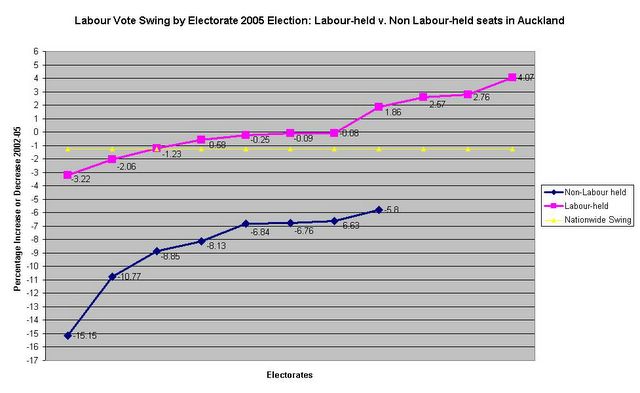
Labour Vote Trend: Labour Held v. Non Labour Held Posted by Picasa

Some extremely interesting trends emerge on analysis of the Election night results.

The primary trend is of increased political polarisation. Simply put, National areas moved to National in proportionately higher numbers than elsewhere, and Labour areas moved away from Labour in proportionately lower numbers than elsewhere.

The overall result saw Labour fall marginally from 41.26% in 2002, to 40.74% on Election night this year, a small swing away from Labour of 1.26%. The polarisation trend can be observed by looking at the Labour vote across Auckland electorates and seeing how this trend was distributed.

The graph above shows three things:
- The flat yellow line in the middle represents the 1.26% fall in the Labour vote across the country.
- The pink line represents Party vote results in Labour-held Auckland seats.
- The blue line represents Party vote results in non-Labour held Auckland seats.

The picture is simple, in all non Labour-held seats, where the Labour vote was weaker to begin with, the swing against Labour has been bigger than the nationwide average. The percentage decrease in the Labour vote in these seats varied between 5.8% (North Shore) and 15.15% (Rodney). Pakuranga was 6.84%.

However, in most Labour held seats, the picture is reversed. In all but two of these seats, the Labour vote held up better than the nationwide average. In four (Mangere, Auckland Central, Manurewa, and Mt Albert) the Labour Party vote actually increased.

The stark differences in Party vote increase/decrease between Labour-held and non Labour-held seats in Auckland confirms the theory of increased political polarisation that has been bandied around in reference to the rural/urban divide.

The trend is also evident within the Pakuranga results.

Our overall Party vote decrease was 6.84%. For administrative purposes the Returning Officer breaks down the booths in the electorate into the geographic sub-groups of Bucklands Beach (worst for Labour historically), Howick (middling), and Pakuranga (best for Labour historically). When the results are broken down into these groups we see:

- Labour vote in Howick down by 14.39%
- Labour vote in Bucklands Beach down by 8.41%
- Labour vote in Pakuranga down by just .79%

If the Pakuranga segment is broken down further to remove the Farm Cove and Sunnyhill booths which are very strong for National, we are left with what we call 'Pakuranga South', the area that has had far and away the strongest Labour vote historically. In this area our vote actually climbed by .91% compared to the nationwide dip of 1.26%. The strongest Labour booths such as Anchorage Park (+2.6%), Elm Park (+4.88%), Pakuranga Heights (+6.02%), and Riverhills (+11.56%) saw good Labour gains.

So internally, the pattern matches the picture across Auckland - National areas solidifying for National, Labour areas solidifying for Labour. Polarisation.

And here's an example of what won this tightest of tight elections for Labour:

Turnout Increase in Pakuranga:

Bucklands Beach (7143-7617) - 6.64%
Howick (7304-7645) - 4.67%
Pakuranga (12649-14110) - 11.55%

Hard graft and on the ground organisation to get out the Labour vote, that's what won it. Despite the Presidential style campaign, flash billboards, blogs, and multi-media gimmicks, it was on the ground campaigning in the end.

Tuesday, September 20, 2005

Campaign Highs and Lows

There's a pile of campaign analysis out there in the blogosphere, and I'll have some on the Pakuranga campaign tomorrow once I've finished the number crunching (some very interesting trends emerging already).

In the meantime, the good bits, and not so good bits from an extremely long, tough campaign in Pakuranga:

Lows

- The poll blues. Whatever anyone says, and whatever you know about long-term trends, margins of errror and the time frames involved, candidates still live and die from poll to poll. Given this, one's mental health took on something of a schitzophrenic quality over this camapign.
- Long days and nights away from home.
- Absolute exhaustion in the last couple of weeks. Literally falling asleep in the middle of phone calls is a good sign that you need a bit more rest.
- The odd socially disfunctional jerk who insists on turning any political discussion into a personal slanging match.
- War wounds. Campaign helpers torn to bits by dogs, strange and horrific blood blisters after hoarding expeditions gone wrong...


Highs

- The door-knocking campaign. Almost universally well-received, and worth the effort when we align the areas we intensively canvassed, with our results.
- Campaign Committee meetings. I had what every good campaign needs - a tight, focussed campaign committee that put together and implemented a sound plan. Thanks Angela, Jeff, Patrick, and John.
- This Blog. Proved to be a good campaign tool, and created more local interest than I had envisaged.
- The debates. The first was an out and out butting of heads with Judith Collins, and I was very happy with the outcome. The second was a lower key, quite fun affair that also went well.
- Assisting local residents. Campaigning brings you into contact with local residents who sometimes need a hand dealing with Council/Govt dept etc... I enjoyed the opportunity to help out in these kinds of cases.
- Campaign blitz days. Hitting targetted parts of the electorate with a group of activists. The best day was when we convereged on the Ennis Ave area in late June, and leafletted and doorknocked the place to within an inch of it's life. We got our best vote increase at the local booth.
- The final burst. That final two week burst of campaigning was exhilirating. We knew that the election could go either way, and that everything we did counted. Alot of coffee and Berocca kept me going.
- The people who spontaneously came out of the woodwork to help. Folk like Louise who helped scrutineer on the day, and Christine whose female presence while giving out education policy information outside schools, ensured that I didn't look like a paedophile.
- The night. What an absolute spectacle. I knew we were going to win when we pulled even, and then the next set of electorate graphics showed Labour strongholds Mangere, Manukau East, and Manurewa with 60-70% of votes still to count.

Tomorrow... the local numbers!

Thursday, September 15, 2005

Every Vote Counts

This will be my last post before Election Day, and if if can communicate just one thing, I hope it is that every vote counts on Saturday.

It is absolutely clear that this is the tightest election race in a generation, and that the choices are very stark.

On Saturday New Zealanders can choose the short-term silver bullet of tax cuts, or we can choose to invest in our shared future.

Over the past six years we have worked hard to build a strong economy that serves all New Zealanders, not just the wealthy few. We have strong growth, low unemployment, decreasing child poverty, and we have implemented a range of positive measures such as the re-establishment of apprenticeships that put us in a good position to prosper in the future.

We have also developed into a proud, confident nation. I have never been so proud to be a Kiwi or a member of the NZ Labour Party as I was when the US & UK illegally and immorally invaded Iraq, and we stood firm on our principles and refused to participate.

This Labour government has not been perfect, but I genuinely believe that we have honoured the commitments we made in 1999 and 2002, and that we have a positive plan for the future. Policies such as interest-free student loans, more modern apprentices, smaller class sizes for 5 year olds, and the expanded rates rebate scheme represent a comprehensive programme to invest in our future, and to share the benefits of our national wealth.

On the local front I have enjoyed the Pakuranga campaign immensely. I can honestly say that I have never worked so hard in my life. We have done everything that we could have to connect with the voters of the electorate, and I have enjoyed the opportunity to meet so many local residents face to face.

For the assistance and support offered by my wonderful campaign team of Patrick, Angela, Jeff, and John, I am incredibely grateful. For my wife's forbearance, patience, and support over the past 9 months of campaigning I am also indebted.

On Saturday I simply ask that Pakuranga voters think carefully about the sort of country we want to build, and look closely at the policies on offer. Any local residents who may find it difficult to reach a polling booth on the day are welcome to contact me for assistance.

Best of luck everyone. See you on the other side!

Campaign Crescendo

From Dawn till dusk and beyond, this week is manic.

Early morning bus stop visits begin each day, followed by getting out the ever huge mountain of deliviries, doorknocking, the odd community group visit, leafleting of parents outside local schools, and 1001 little tasks to keep the campaign ticking over.

This week also saw Pakuranga's only two real campaign debates.

The first, on Monday night was organised by the combined local Catholic Parishes. This was the bigger of the two, with roughly 100 people in attendance. Each speaker had to address 4 topics, and the floor was then opened for questions. National was represented by Judith Collins, and from her very first response on abortion which she used to make a Party political point over the parental consent issue, it was clear that we were not going to have a happy night.

Over the next couple of hours, her behaviour deteriorated. While I actually quite enjoy a bit of good heckling, Mrs Collins behaved in an increasingly petulant manner, rudely nattering away while others spoke, mouthing 'Shutup' to someone in the audience who dared to disagree with her, questioning the right of the audience to ask the questions they wanted, and finally refusing to answer a direct question on the Iraq war. Being a helpful fellow I politely stepped into that paticuar breach.

I got on fine with other canidates from across the political spectrum, and simply sould not fathom Mrs Collins sourness.

The second debate, organised by Oxfam, Amnesty, and the UN Association was completely different. It was quite a bit smaller and better humoured. Maurice attended this one, and although we got stuck into each other a few times, it was all in good spirit - the way it should be.

We'll be continuing to campaign right until the final whistle. I think this is still an extremely tight election and think that this will be reflected in polls over the next couple of days. Turnout and leadership will be the decisive factors.

Sunday, September 11, 2005

The Polls go crazy

The polls are all over the place:

Colmar Bruton last Sunday: Nats 9 ahead
Midweek TV3: Labour 9 ahead
Herald Friday: Deadheat
SST today: Nats 7 ahead
Herald on Sunday (snap): Labour 3.5 ahead.

...with a Colmar Brunton poll coming tonight which the Herald on Sunday suggested would contrast with the SST result.

What to make of it? Two things I think. The first is that there is exceptional volatility, particularly in National's vote. Secondly, there is no doubt heading into the final week that it is very close.

In my view, a combination of the Leaders performances, and on the ground organisation to turn out the vote, will probably decide the election.

Knife edge stuff!

Friday, September 09, 2005

Best Day Yet

Great day of campaigning today.

Leafleting at Pakuranga Plaza bus stop kicked things of this morning. This went well again, with another very positive reaction from students to the interset-free policy.

Then a big leafletting drive through the day. The best thing about this was that about half a dozen people stopped me to chat along the way, and offered their support.

Lunch was good too. Labour was nicely ahead in the Pakuranga Muffin Break coffee bean poll!

The afternoon saw a bit of hoardings maintenance, including the replacement of one of our horror sites in Howick that seems to get hit every second night. I won't attempt to describe what was written and drawn on this one! Again, a number of passersby offered their support. We also put up a fantastic new sign in Half Moon Bay that was offered by a supporter who called us up and suggested the use of his property.

The day was rounded off by an extremely positive bout of campaigning along Casurina Rd in Pigeon Mountain. There was hardly a negative response.

A bit of a dream campaign day really, and I'm quite ready to be brought back to earth tomorrow!

Wednesday, September 07, 2005

Gone by Lunchtime

This is very funny.

Mainly because it is true. All it does is quote back Brash's various contradictory positions on a range of issues.

Not everyone 'likes' Helen Clark or agrees with all of Labour's policies, but a number of right leaning voters have told me during the campaign that at least they know what they are getting with her. With Brash, who knows what the policy will be next week? His comment the other day that he could not comment on National's housing policy because he had not "read the press statement" was a new low.

I think that this leadership issue will be a critical one in these closing weeks of the campaign.

Wednesday in Howick

It has been a good days campaigning.

I began with some leafletting of people at the Highland Park bus stop this morning which went very well. Naturally, many of the people at the bus stop were students going into Auckland University and AUT, so the response to our interest-free policy was very good.

The middle of the day was taken up by a lot of leafletting around the central Howick area. We seem to be getting quite a good response to this. In 2002, I received very few phone calls or e-mails in response to our leafletting, but this time there is steady daily feedback, and most of it is good, or at the very least, genuinely undecided and enquiring.

Lunch was an extremely unhealthy visit to the Roast Dinner store on Aviemore Dr where I had my first after school job. I can heartily recommend this place - they were doing the roast dinner thing when there were only about 3 such stores in Auckland, and they still do a mean pork roll.

More leafletting in the afternoon, followed by a bit of doorknocking in central Howick, then home to work on various bits of campaign administration.

More of the same tomorrow...

Monday, September 05, 2005

Nats in Eastern Corridor Spin??

I caught the end of a One News item this evening which seemed to show Don Brash over-ruling Maurice Williamson on the Eastern Corridor issue.

Maurice once again extolled the virtues of the corridor at the debate I had with him over transport policy a couple of months ago, so I would be extremely interested to know if this was the case.

There doesn't yet seem to be anything online... did anyone see the full story?

Hard Slog Ahead

It has been an exceptionally busy week, hence the lack of recent blog entries.

The last few days in particular have been hectic. Our second major electorate-wide electorate has been parcelled out to our team of deliverers across the electorate, I've had a cluster of speaking engagements with local community groups, door knocking in the Pigeon Mountain area has commenced, the signage network has been expanded (and repaired where necessary), and I have commenced bus stop visits to meet local residents first thing in the morning.

I've had some particularly enjoyable meetings with the Shakti Seniors group, the Selwyn Seniors, and Half Moon Bay Rotary. People at the meetings were extremely interested in the election, and had plenty of searching questions. I appreciated the opportunity.

The recent polls suggest a hard slog ahead for Labour to win a third term, so the next two weeks promise to be even busier. I am on annual leave now, so campaigning is now a full-time activity.